Pastors of Grace Chapel Baptist Church: Mike Argabrite and Andy Smith

Pastors of Grace Chapel Baptist Church: Mike Argabrite and Andy Smith
This blog serves in an effort to elaborate on topics that we are studying. This is done with the purpose of provoking thoughtful discussion among the people of Grace Chapel as well as anybody who might stumble onto our blog page. The discussion can take place publicly on this blog or in private conversation.
Showing posts with label Calvin quote. Show all posts

Wednesday, July 8, 2009

The Last Calvin Quote (for now...maybe...well, we'll see!)

Here is Calvin's explanation of the effects of regenerating grace. Notice his "new creation" terminology. He is implicitly speaking about the restoring of God's image to man through the work of the Spirit.

"It would be right to think about the remedy divine grace provides for correction and curing natural corruption. The Lord, in coming to our aid, gives us what we need and thereby reveals our helplessness. When the apostle says to the Philippians, 'being confident of this, that he who began a good work in you will carry it on to completion until the day of Christ Jesus (Phil. 1:6), there can be no doubt that by the good work begun he means the first step of conversion in the will. So God begins the good work in us by arousing in our hearts a desire, love, study of righteousness. More accurately, he turns, trains, guides our hearts to righteousness. He completes the good work by strengthening us to keep going to the end. In case anyone tries to quibble that the good work done by the Lord consists in helping the will (which is weak in itself), the Spirit states what the will is able to do on its own. 'I will give you a new heart and put a new spirit in you; I will remove from you your heart of stone and give you a heart of flesh. And I will put my Spirit in you and move you to follow my decrees and be careful to keep my laws' (Ezek. 36:26-27). How can it be said that the weakness of the human will is merely assisted effectively to choose good things, when in fact it must be totally transformed and renewed? If there is any softness in a stone or you can make it malleable, then you could say that the human heart could be reshaped correctly, so long as the imperfect is assisted by divine grace. If the Spirit intends to show that no good thing can ever be drawn from our hearts, unless they are made new, we must not try to share with him what he claims for himself alone.


It is like turning a stone into flesh, when God gets us to follow the right way, everything belonging to our own will is abolished, and what succeeds is wholly of him...I maintain that this is totally God's work, because as the apostle teaches, 'Not that we are competent to claim anything for ourselves' (2 Cor. 3:5). In Philippians 2:13 he says not merely that God helps the weak or corrects the depraved will, but that he works in us to will. From this we can infer that everything good in the will is entirely the result of grace. In the same way the apostle says, 'There are different kinds of working, but the same God works all of them in all men' (I Cor. 12:6). He is not referring to universal government, but stating that all the good qualities which believers possess are due to God. In using the term 'all', he definitely makes God the Author of spiritual life from beginning to end. He explained this in different terms when he said that 'there is but one Lord, Jesus Christ, through whom all things come and through whom we live' (I Cor. 8:6). Here he plainly extols the new creation, by which everything in our common nature is destroyed. There is a tacit antithesis between Adam and Christ, which he explains more clearly when he says, 'For we are God's workmanship, created in Christ Jesus to do good works, which God prepared in advance for us to do' (Eph. 2:10). He shows in this way that our salvation is gratuitous, because the beginning of goodness is from the second creation, obtained in Christ. If we had the slightest ability in ourselves, there would be merit. But to show our complete destitution, he argues that we merit nothing because we are created in Christ Jesus to do good works, which God has prepared. He implies by these words that all the fruits of good works are straight from God. So the Psalmist, after saying that the Lord has made us, immediately adds 'not we ourselves', to take from us any share in the work. It is obvious from the context that he is referring to regeneration, the beginning of spiritual life, because his next words are, 'we are his people, the sheep of his pasture' (Ps. 100:3). Not content with simply giving God the glory for our salvation, he specifically excludes us from any part in it. Man has not an atom of cause to boast. The whole work is God's" (98-100).

Tuesday, July 7, 2009

Much More Calvin to Make You Think (Part 3)

Here is Part 3 on the Calvin posts:

"Now we have a problem to solve. In every age there have been people who, by nature, wanted to lead good lives. Of course, many faults could be found in their behavior, but simply by following virtue they showed the element of purity of characters. Such examples keep us from thinking that the nature of man is totally evil, since some have been outstanding in noble acts as well as behaving with integrity throughout their lives. We must realise that, despite our fallen natures, there is room for divine grace. This grace will restrain the heart inwardly without cleansing it. If the Lord allowed every mind to do exactly what it wanted, it is quite certain that each of us would show our nature to be capable of every crime Paul mentions. Tell me, are you completely innocent of murder and theft? Don't your lips speak deceitful, spiteful things? Aren't your actions often wrong or harmful? Our souls are without God; our inmost beings are sinful; we are devious and malevolent with every part of us capable of lifelong evil (Rom. 3:10-18). If we are at all like this (and the apostle says so clearly) it is easy to see what would happen if the Lord allowed human passion to have its way. No wild beat would rush with such fury, no stream, however rapid and turbulent, would burst its banks so boisterously. God heals the elect of these evil things; others he only restrains so that they do not break out in a way which makes it impossible to maintain law and order.


However much such people disguise their sinfulness, some are held back from action only by shame, others by fear of the law. Some try to live an honest life, thinking it to be in their own interest, while others rise above common folk, so that by dignity of rank they can keep inferior folk in their place. So God, by his providence, curbs the perversity of nature, preventing it from breaking out in action, but not making it inwardly pure" (94-95).


Next time we will look at Calvin's description of "divine grace".

Thursday, July 2, 2009

A Little More Calvin to Make You Think

Continued from yesterday's post on Calvin:

"There is discernment in the human mind to this extent, that it is naturally influenced by the love of truth: the neglect of this in the lower animals is proof of their base unreasoning nature. However, this love of truth fades out before it reaches the goal and then falls away into vanity. Because the human mind is unable, through obtuseness, to follow the right line of enquiry, after various attempts and stumbling from time to time like a person groping in the dark, it eventually gets utterly confused. This just proves how unfit the mind is to search for the truth and to find it. It labours under another serious defect, in that it often fails to discern what sort of knowledge it should try to acquire. So, influenced by mere curiosity, it tortures itself with unnecessary and useless discussion, either not referring at all to essential matters or giving them only a superficial and contemptuous glance. It hardly ever studies them with serious purpose...I do not dispute that some philosophical writings occasionally come across some wise and relevant comments on the nature of God, but they are invariably tinged with confused fantasies. The Lord has given such philosophers a slight awareness of His Godhead, so that they cannot plead ignorance as an excuse for blasphemy. At times he has prompted them to proclaim their views in such a way as to be their own condemnation. Seeing, they saw not. Their discernment was not enough to lead them the truth, far less to grasp it: it was like that of a confused traveller seeing his surroundings momentarily by a flash of lightning, and then disappearing before he can move a step. Such assistance can never help him to find the right path. Many wicked lies get mixed up with the tiny particles of truth in the writings of these philosophers. Not one made the slightest contribution to the assurance of divine favour, without which man's mind will always remain in the chaos of confusion. Human reason cannot begin to answer the great questions as to what God is in Himself, and what He is in relation to us" (93-94).


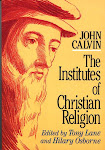
Stay tuned for part 3 tomorrow as I will quote Calvin's explanation of the only answer to man's dilemma. In addition, someone informed me that the particular version of Calvin's Institutes that I placed as a recommended book was too expensive, so I replaced it with an abridged version that can be purchased via Christian Book Distributors (look on right side of blog page and just click on the picture of the book). I own both the abridged and unabridged versions. Currently, I am reading through the abridged version. It is translated nicely by Henrey Bevenridge. Hilary Osborne tweaked the translation to make it even better. I am not a fan of anything abridged, but with this abridged work you get a great feel for the overall contents of the complete version of the Institutes. Plus, the abridged version is only $12.99.

Blessings,
Andy

Wednesday, July 1, 2009

A Little Calvin to Make You Think

In Sunday’s message I set forth the notion that sin does not completely remove the image of God that man bears. Rather, the image bearing is marred (not removed or destroyed entirely) because of sin. Man is still depraved and his free will is ruined, yet he is not as sinful as he could be, and he has not lost all sense of intelligibility. This is simply due to God’s common grace. In our passage (Colossians 3:8-11), Paul speaks about the restoring of God’s image. This is the concept behind the words “renewed” (vs. 10), and “renewal” (vs. 11). The concept is simple to grasp- at the point of regeneration God begins a specific work to restore the image of God on the soul. As I said Sunday, the process of sanctification (which necessarily flows from regeneration) actually restores God’s image in a superior manner than even Adam possessed. This is due to the fact that the image Adam bore of God (pre-fall) did not contain the knowledge of God’s redemptive love.

Many of you know that I am re-reading Calvin’s Institutes of the Christian Religion (click on the picture of Calvin’s work on right side of blog page to read about this book). Six years ago, in my first semester of seminary, I read through it for the first time. Calvin has impacted me since. I use all of his commentaries, and often reference the Institutes. I decided to read through it again (six years later…and on the back side of my seminary experience) in order to see how Calvin has shaped my understanding of the Gospel and theology in general. I would like to share with you a quote that pertains to the topic of man bearing God’s image. The quote comes from my reading yesterday. In this particular quote, Calvin is essentially arguing that man’s innate quest for truth through human reasoning is a result of the residue of God’s image that he retains, though he is a sinner. However, by quoting John 1:5 Calvin strongly implies (and states elsewhere for that matter) that the specific work of regeneration by the Spirit of God is the only thing that reveals truth (the Gospel) to man. He will never attain it on his own.


“When man withdrew his loyalty to God, he was deprived of the spiritual gifts which had lifted him to the hope of eternal salvation. So it follows that he is an exile from the kingdom of God and everything which belongs to the spiritual life is extinguished, until he regains them by the grace of regeneration. Among these are faith, love to God and neighbor and the study of righteousness and holiness. When these are restored to us by Christ, they might be thought of as above and beyond nature. Then we infer that they were once wiped out. At the same time, soundness of mind and integrity of soul were withdrawn and it is this which produces the corruption of natural gifts. Although there is a residue of intelligence and judgments as well as will, a mind which is weak and darkened cannot be called sound and whole. The depravity of the will is only too well known. So, since reason, by which he understands and judges, is a natural gift, it could not be completely destroyed. But because it was weakened and corrupted to some extent, only a shapeless wreck is left. In this sense we read in John 1:5, ‘The Light shines in the darkness, but the darkness has not understood it’. These words clearly express both aspects. First, that there are still some sparks in man’s perverted and degenerate nature which shows that he is a rational animal. He differs from the lower orders because he possesses intelligence¸ but the light of it is enveloped in dark clouds so that it cannot shine out effectively. In the same way, because the will is inseparable from man’s nature, it did not perish, but became so bound by depraved lusts as to be incapable of worthy desires. It is contrary to the Word of God and to common experience to maintain that the intellect is forever blind, with no capacity at all. A longing to investigate the truth has been implanted in the human mind, and it would never rise to this unless some appetite for truth had existed from the beginning” (91-92).


Stay tuned for the second half tomorrow….
Blessings,
Andy